Come As You Are: A Case for Hosting With Dishes in the Sink
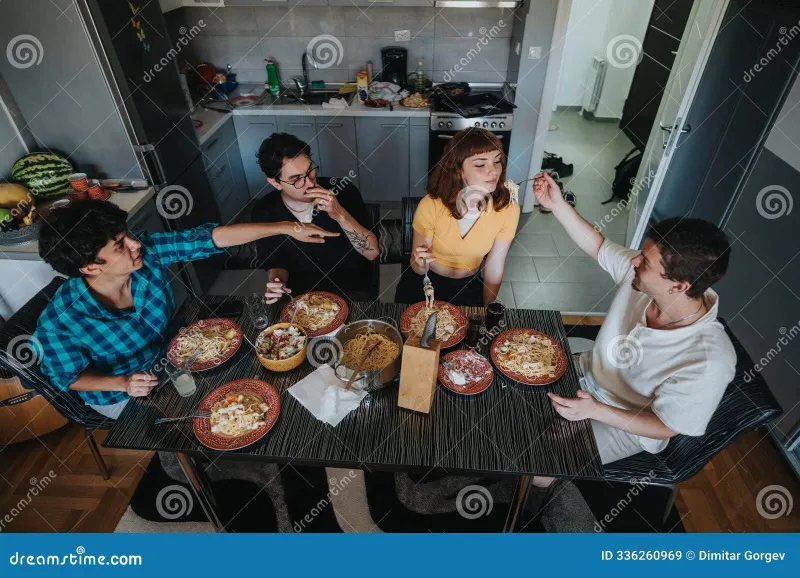
Photo: casual dinner party friends messy kitchen cozy home, via thumbs.dreamstime.com
The Lie of the Perfect Living Room
I want to tell you about the best party I ever attended. There were eleven people crammed into a kitchen the size of a parking space. The counter was buried under unopened mail. A toddler was sticking magnets on the dishwasher. My friend Dana served chili out of a dented pot and we stayed until midnight because nobody wanted to leave.
Nobody remembers Dana's baseboards. Everybody remembers that night.
And yet, somewhere along the way, American friendship got tangled up with interior design. We started believing that having people over requires a home that looks staged — fresh flowers, throw pillows in a color story, a bathroom that smells like eucalyptus. We call it being a good hostess. I call it a barrier to entry that's keeping us lonely.
The Waiting Game Nobody Wins
Here's how it usually goes. You think about inviting friends over. Then you look around at the laundry situation, the Legos under the couch, the light fixture that's been half-dead since the Super Bowl. You think, I'll have people over once things are under control.
But things are never under control. Life is not a showroom. So the invitation never goes out, and the friendship lives entirely in texts and "we should really get together sometime" — a phrase that has done more damage to American friendship than any scheduling conflict ever could.
I did this for years. Then my mother-in-law — a woman who raised four kids in a house where the couch cushions were never flipped right — said something that reframed everything for me: "A home that's too nice for company is a home that's too lonely for you."
What Hospitality Actually Is
Hospitality is not entertaining. Entertaining is a performance with an audience. Hospitality is a welcome mat.
When your house is a mess and people come anyway, you're telling them something profound: I want you here more than I want to impress you. That's intimacy. That's the good stuff. A friend who's seen your unfolded laundry is a friend for life.
There's a reason the deepest friendships form in dorm rooms and first apartments — tiny, chaotic spaces where nobody had matching dishware. We've been told we outgrow that. I'm arguing we shouldn't.
Your Permission Slip, With Scripts
Consider this your official invitation to lower the bar. And because I know the words are the hard part, here are some starters:
The anti-apology invite: "We're having soup Thursday — nothing fancy, come at 6." No apology about the mess. None. Apologizing for your home tells guests they should have expected better.
The honest one: "The house is a disaster and I refuse to clean it. Come anyway?" Nine times out of ten, the answer is "same, on my way."
The zero-effort version: "I'm ordering pizza Friday at 7 if you want in." This is not sad. This is efficient love.
The reciprocity breaker: "You've seen my kitchen clean. Time to see it real." People are starved for permission to be imperfect. Your messy counter might be the release valve they needed.
Soup, Toys, and the Long Game
My house right now, as I write this: a puzzle half-finished on the dining table, a soccer ball behind the couch, and a pot of chili I'm making for tonight's guests — two neighbor moms I've been meaning to have over for eleven months.
Eleven months. That's what the perfection myth costs us.
So here's my manifesto, short and sweet: Have people over with dishes in the sink. Serve soup from a dented pot. Let the kids run wild and the conversation run longer. The friends worth keeping don't care about your throw pillows.
They care that the door opened. And that you didn't pretend to live anywhere but exactly where you do.